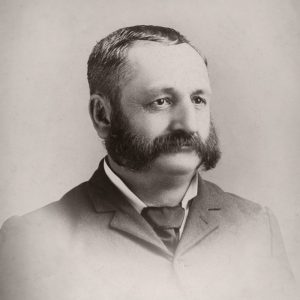
JBF Champlin
Cutlery Salesman, Entrepreneur and Visionary

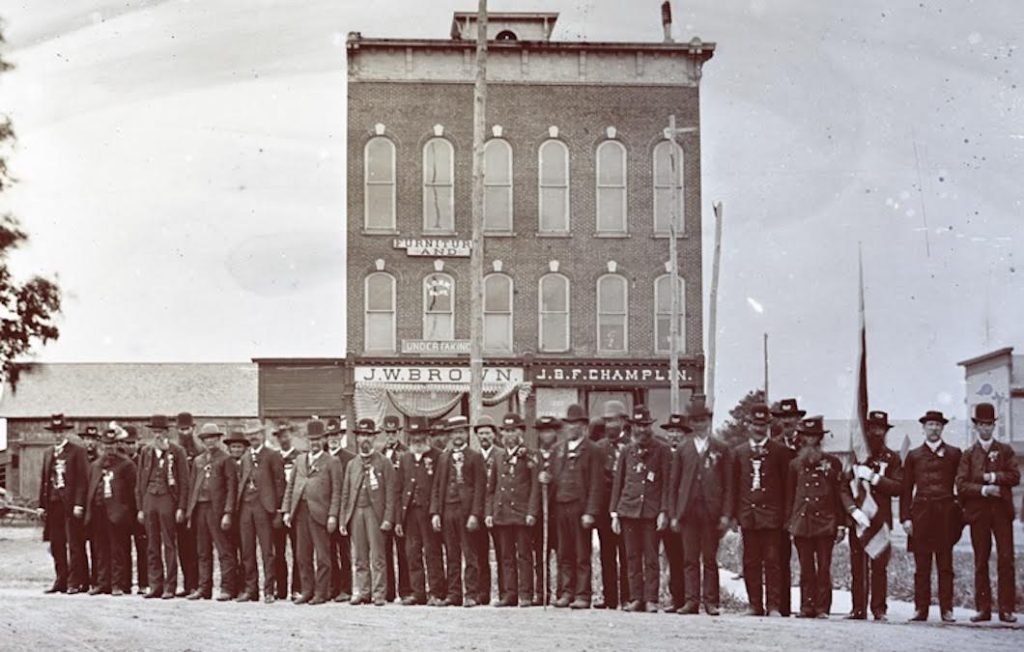
In 1882, after years with the cutlery-importing firm Friedmann & Lauterjung of New York, J.B.F. Champlin set out on his own, establishing a wholesale cutlery business in Little Valley NY with its headquarters being the impressive Opera House in downtown Little Valley. He contracted with manufacturers to produce quality cutlery bearing his own name and brands, which were sold through hardware stores and other retail outlets.
Champlin had married Theresa Case in 1861, and her four brothers were involved in the business from its early years. As the enterprise expanded, the company name changed from “J.B.F. Champlin” to “J.B.F. Champlin & Son” and once again when they incorporated in 1887. The stockholders were all members of the Champlin and Case families. The American cutlery industry would never be the same
The name brand was long lost in cutlery lore, with some small custom productions made with Mike Losisco and Derek Smith, until Lonnie & Kim Basham (founder’s of Red Hill Cutlery) purchased the name brand in 2025. With Lonnie’s extensive involvement in the pocketknife community, he promises to renew the name of J.B.F Champlin, The Father of American Cutlery.
The American Civil War was barely five months old when J.B.F. Champlin and Theresa Mary Case were married in September of 1861. J.B.F. was twenty years old and Theresa just sixteen. Their birthdays fell only one day apart. They both had grown up in the small rural community of Napoli, in western New York’s Cattaraugus County.
Life on the farm was difficult, and from an early age J.B.F. learned to supplement the family income through trading, bartering, and selling goods whenever the opportunity arose. He also spent several winters driving ox teams for lumber camps, work that went hand in hand with his selling as he moved about the region. Champlin possessed a natural talent for sales and merchandising. He was outgoing, resourceful, and genuinely enjoyed dealing with people. With support from his wife, he left western New York to pursue greater opportunities and seek his fortune as a cutlery salesman in New York City.
Trained salesmen of the day were typically polished, well-dressed men, skilled in their craft. By comparison, J.B.F. was almost comical, wearing his homemade suit and carrying his samples in an ordinary half-bushel basket. Even so, he was remarkably successful. He sold more knives than the two small factories he first represented could produce.
His success eventually attracted the attention of J. Christopher Friedmann of the large New York cutlery importing firm, Friedmann & Lauterjung. The two men entered into an unusually long agreement under which J.B.F. would travel the region as a salesman for F&L for the next fifteen years. As it turned out, he represented the firm for more than sixteen years and became one of the most successful men in the business. He could easily have retired at the end of that contract.
Instead, he chose to establish his own wholesale cutlery firm in his adopted hometown of Little Valley, New York, hoping to stimulate the local economy and give people in the area a chance for employment. J.B.F. knew all too well what it was like to be young, eager, and underemployed. In 1880 he completed the Champlin Opera House, a large three-story building that became an important center for business, entertainment, and public gatherings in the area.
By early 1883, Champlin’s cutlery business was fully underway. His company purchased heavily from manufacturers and importers while employing his own traveling salesmen who supplied hardware stores and retailers throughout the region.
From the earliest days of the enterprise, Theresa’s four brothers—John D., William R., Jean, and Andrew J. Case—were involved in the business in various capacities. The new business went through several name changes in quick succession. At first, the company was simply known as “J.B.F. Champlin.” Around 1886 the name expanded to “J.B.F. Champlin & Son.” In early 1887, the family incorporated the enterprise as the “Cattaraugus Cutlery Company.” The original stockholders and directors were all members of the Champlin and Case families. This was truly a family business. During its early years, much of the cutlery handled by the company was imported
Although the working relationship between J.B.F. and the Case brothers was short-lived and largely over by the end of 1888, those early years working with Champlin introduced the enterprising young Case men to the cutlery trade and helped set the stage for their future dynamic careers within the industry.
In 1890, with the new McKinley tariffs on the horizon, J.B.F. took a leap of faith to keep his company competitive in a changing business environment. It had become apparent that Cattaraugus Cutlery would soon need a factory of its own. His first step was purchasing manufacturing equipment from the defunct Beaver Falls Cutlery Company. Next came construction of a factory building, followed by the daunting task of recruiting skilled craftsmen capable of producing high-quality pocketknives.
Within only a few years, J.B.F. and Cattaraugus employed 150 workers producing some of the finest cutlery made anywhere in the country. Champlin was no stranger to the factory floor. As his duties allowed, he would walk through the factory to make sure everything was running smoothly. It was not uncommon for him to sit down at a workstation and personally perform whatever work was needed to keep production on schedule.
In 1895, J.B.F. started a second factory in Little Valley that would eventually become Cattaraugus Factory No. 2. He was also instrumental in getting the George W. Korn Razor Manufacturing building established next door.
J.B.F.’s example of what could be accomplished through hard work, and personal drive inspired many others to try their hand in the business. Within little more than a decade, at least seventy other cutlery-related manufacturers and businesses sprang up within one hundred miles of Little Valley. So, dear reader, as you enjoy the favorite knives in your personal collection, ask yourself: would you be holding these treasures in your hands today, if J.B.F. Champlin had not set such a fine example and inspired so many others to follow?